TABLA
For
a more detailed and bigger size click on the thumbnail

Tabla Five Star
|
|

Tabla Standard
|
| |
|
|

Tabla Premium
|
|

Tabla Student
|
Sound
Sample

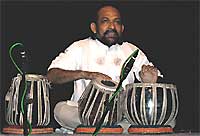
The Tabla is regarded as the
queen of drums and percussion instruments and is the
most popular Indian rhythm instrument. It consists of
two drums, the Bayan (big bass drum) and the Dayan.The
two of them are almost always played together. Both
the two drums as a pair and also the Dayan on its own
- as opposed to the Bayan - are called Tabla.
Both
drums have a body that is closed at the bottom. The
open top is mostly covered with a goat leather skin.
To the edge of this basic skin, a second skin (Kani)
is attached. In the centre of the skin is the so-called
GAB: a black area which gives the instrument a special
sound and makes the variety of sounds and modulations
possible. It is a fine art to apply this GAB in the
correct mixture, consistency and strength of a paste
which consists mainly of rice flour and iron filings.
When playing, the two drums are placed on rings (Bira)
which support them. The tuning wedges that are held
by leather straps at the sides are meant for tuning
the instrument. Depending on whether the wedges are
beaten upwards or downwards by the tuning hammer, the
sound gets lower or higher. A fine tuning is done by
beating with the tuning hammer on the woven ring around
the skin.
The
playing technique requires a differentiated fingering
in connection with the complex composition of the skin
membranes. The combination of the two drums produces
an incredible fullness and details of different rhythm
structures and this fullness of expression is unmatched
by any other rhythm instrument.
The skins of the Tabla are likely to wear out and have
to be changed from time to time, depending on how often
the instrument is played and what kind of conditions
it is exposed to. Even when the instrument is very old,
it can, when the substance i.e. the wooden body is o.k.,
be restored to a wonderful instrument by a new skin.
This task should generally be done by an expert.
BAYAN
The Bayan takes on the bass part of the drum duo. The
body of the Bayan is mostly made of chrome-plated copper.
The Bayan is played by the index finger and the middle
finger of the left hand in turns or with both fingers
simultaneously. While doing this, the ball of the thumb
rests lightly on the edge of the skin or modulats the
pitch by slightly pressing the skin.
DAYAN
The Dayan is made of different types of wood. Please
see the explanations on this topic in the next paragraph
about the meaning of the wood regarding the quality
of a Dayan. It is customary, especially in Kolkata,
to hollow out the inside of the body of a Dayan relatively
roughly. The tuning wedges that are held by leather
straps at the sides are meant for tuning the instrument.
Depending on whether the wedges are beaten upwards or
downwards by the tuning hammer, the sound gets lower
or higher. A fine tuning is done by beating with the
tuning hammer on the woven ring around the skin. The
size of a Dayan is defined by the diameter of the skin.
Sizes of 5 to 6 inches are in use. The standard sizes
are about 5 1/4 inches to 5 1/2 inches whose tuning
is around C. The measurements can also be given in centimeters.
The tuning of a Dayan depends on the skin diameter.
The smaller the skin is, the higher is the sound of
the Dayan; the bigger the skin diameter, the lower it
can be tuned. Specially low or high Dayans are played
together with corresponding high or low melody instruments.
TYPES OF WOOD FOR DAYAN AS QUALITY FACTOR
There
are different woods which Dayans are made of. The most
used and well-known types of wood are Shisham, Neem,
Mahagony and Babla Wood. Basically it is not possible
to choose a good Dayan only from the kind of wood it
is made of. Of course the wood is important for the
continuous sound of a Dayan but also other factors such
as the quality of the skin, the quality of the Gab and
of course the manufacturing are important. When the
manufacturer chooses the wood, then 1st priority is
that the wood is completely dry. As the situation in
India is that the manufacturers of Tablas have worldwide
orders for many months, they do not get enough good
wood. They send abroad whatever they can get. The wood
very often is not dry enough. This is a very big problem.
Another
important factor is the density of the wood depending
from which part of the tree the wood is taken (upper
or lower portion of the trunk) or if the wood is taken
from a thin trunk. The thick trunk, which is the good
wood, mostly is used for the furniture industry specially
if it's a valuable wood like Shisham or Neem. This results
in the fact that it is mostly better to use a good dry
wood with good density from a no-name wood instead of
a well-known wood as Shisham or Neem. It needs a well
experienced person to evaluate what really is a good
wood for good sound in a Dayan. It can be the case that
one gets a Shisham-Dayan which signals that it is a
good Dayan, and finally it turns out that it is a terrible
Dayan.
It
can be seen that the name of the wood, which a Dayan
is made of, does not really give an objective evaluation.
Sometimes a no-name wood of a Dayan which is completely
dry, has a fantastic density, a good skin and gab and
is made by a good experienced and reliable maker, is
much better than a precious wood.
Still,
we would like to mention below some of the types of
wood that are well-known and much in demand:
Shisham
Is first of the much sought-after kinds of wood,
but it is absolutely necessary that it really comes
from a thick trunk with a good density, otherwise Shisam
wood is not good at all.
Neem
Also a very popular wood. Must also come from a
thick trunk, otherwise it splits over the course of
time. If, however, it is really taken from a thick trunk
and has been completely dried, then even a split that
forms in the course of time, does not influence the
good sound at all.
Mahogany
Is of a similar quality as Neem and reacts in the
same way as Shisham wood.
Wood
of the Five Star Quality
Due to the great efforts of Tabla Maestro Sajal Karmakar,
we always get best quality of wood for the making of
the five star Dayan. He looks for the right wood himself
and even though he already buys the best available wood,
he dries it himself for several months in a special
procedure only to make sure to get high-quality professional
instruments.
Tarang
offers different qualities of Tablas.
For
further information please click on the banner

TARANG
offers on principle only high-qualtiy musical instruments.
This is made possible by close personal contact to the
suppliers and a strict selection of the instruments
that are included in our range of goods. We do not offer
any instruments which reach the west from unknown sources
via importers and which are often resold by middlemen
without any quality check and setting of the instrument.
The demand from the west is relatively high in India.
The purchase prices are negotiated to the lowest limit
by the western countries, especially for high ordered
quantities. This has effects on the required care and
circumspection in craftsmanship, on the experience and
mentality of the commissioned manufacturer and the use
of parts of the instruments that are often of a poor
qualtity. Irrespective of the qualification of the skill
in craftsmanship, this leads, in some cases, to results
that do not deserve the name instrument. Thus it is
easily comprehensible that it is essential, when bying
an Indian instrument, to know the sources. TARANG only
supplies instruments from indisputable sources. All
instruments are delivered adjusted and ready to be played.
Of course, we understand that somebody who purchases
an instrument is also dependent on accessories and spare
parts. Also in this respect we can satisfy the needs
of our customers. Should an instrument be defective
at any time, we can arrange for appropriate restoration.
As a rule we can deliver any instrument offered on our
website within 1 - 2 weeks. Our international lists
of teachers enable everybody to find information about
a teacher in their proximity. You can expect from us:
reasonable prices, prompt service and straightforward
processing of purchase and delivery.
The
financial aspect also has to be mentioned. Despite the
high quality we offer, we also do our best to offer
you these instruments at very competitive and reasonable
prices.