Kathak
The
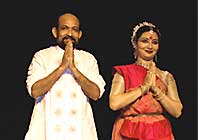
Kathak dance form originated in the north and at first
was very similar to the Bharatanatyam. Persian and
Muslim influences later altered the dance from a temple
ritual to a courtly entertainment. The influence of
the Mughal tradition is evident in this dance form,
and it has a distinct Hindu-Muslim texture.
The dances are performed straight-legged and the ankle
bells worn by the dancers adeptly controlled. Kathak
has an exciting and entertaining quality with intricate
footwork and rapid pirouettes being the dominant and
most endearing features of this style. The costumes
and themes of these dances are often similar to those
in Mughal miniature paintings.
Though not similar to the Natyasastra, the principles
in Kathak are essentially the same. Here, the accent
is more on footwork as against the emphasis on hasta
mudras or hand formations in Bharatanatyam.
Top
Bharatnatyam
Of
the various forms of classical dance in India, Bharata
Natyam is believed to be the oldest, because it is
the form which is based to the largest extent, on
ancient texts on the dance. For centuries it was danced
by Devadasis in the temples of south India. Movement,
mime and music contribute in equal measure to this
beautiful dance from Tamil Nadu. It is a solo, dance
which is devotioal in spirit. Highly stylised and
sophisticated in its technique, Bharata Natyam is
evenly divided between nritta, pure dance, and nritya,
expressinal compositions. The songs pertain mostly
to the theme of love but not sensual love. These are
given an elevated and somewhat spiritual flavour.
A
Bharata Natyam performance begins with alarippu, an
invocatory number which is structured to give the
effect of the body unfolding itself by degrees, as
if in offering to God. The dancer begins with a sidelong
glance, executes a lateral glide of the neck, and
then fans the movement out to each part of the body.
As she showers alternately silken and steely blows
in space, in strict rhythm with the drum, the mridamgam,
and the syllables sung by the nattuvanar, the conductor,
the feet adorned with ankle bells change scores of
rhythmic patterns.
The
dancer's skill at both pure dance, seen elsewhere
in items like jatiwaram and tillana and in mime compositions
like shabdam and padam, finds its acme in varnam.
This is the central piece of a Bharata Natyam recital
and makes the greatest demands on the dancer's stamina
and emotinal resources.
Top
Kathakali
A
rich and flourishing tradition of dance drama can
be witnessed in the picturesque state of Kerala, a
narrow strip of beautiful land running along the west
coast of India. Here, in the night, the drums roll,
beckoning an audience to a most magnificent spectacle.
Kathakali, a well-developed dance-drama, is a performance
where the actors depict characters from the epics
Ramayana and Mahabharata and from the Puranas (ancient
scriptures). The dancers adorn themselves in huge
skirts and head-dress, wearing a most intricate style
of make-up.
Kathakali
draws heavily from drama and is danced with elaborate
masks and costumes. Kathakali recitals are generally
long and while other dance forms are more emotive
than narrative, Kathakali is both. It combines dance
with dialogue to bring myth and legend to life in
the temple courtyards of Kerala. The dancers use their
stunning costumes and make-up, with the accompaniment
of drums and vocalists, to create various moods and
emotions.
So
strong is the identification of the dancers with the
characters they play and so absolute their conviction,
that they seem to surpass themselves, becoming one
with the legendary heroes and heroines they depict.
Top
Kuchipudi
Kuchipudi,
the indigenous style of dance of Andhra Pradesh took
its birth and effloresced in the village of the same
name, originally called Kuchelapuri or Kuchelapuram,
a hamlet in Krishna district. From its origin, as
far back in the dim recesses of time as the 3rd century
BC, it has remained a continuous and living dance
tradition of this region. The genesis of Kuchipudi
art as of most Indian classical dances is associated
with religions. For a long time, the art was presented
only at temples and that too only for annual festivals
of certain temples in Andhra.
According
to tradition, Kuchipudi dance was originally performed
only by men and they all belonged to the Brahmain
community. These Brahmain families were known popularly
as Bhagavathalu of Kuchipudi. The very first group
of Brahmain Bhagavathulu of Kuchipudi was formed in
1502 AD. Their programmes were offerings to the deities
and they never allowed women in their groups.
Kuchipudi
art, to be noted was intended as a dance drama requiring
a set of character, never as a mere dance by a soloist
which is common in present times. This dance drama
are sometimes known as Ata Bhagavatham. The plays
are in Telugu and traditionally all roles are taken
by men alone.
Kuchipudi
plays are enacted in the open air and on improvised
stages. The presentation begins with some stage rites
which are performed in full view of the audience.
Then the Soothradhara or the conductor and the supporting
musicians come on the stage and give a play of rhythm
on the drums and cymbals. In a Kuchipudi performance,
each principal character introduces himself or herself
on the stage with a daru. A daru is a small composition
of dance and song specially designed for each character
to help him or her reveal his or her identity and
also to show the performer's skill in the art. There
are nearly 80 dharus or dance sequences in the dance
drama. Behind a beautiful curtain held by two persons,
Satyabhama enters the stage with her back to the audience.
In Bhama Kalapam, Satyabhama is Vipralamba Nayaki,
ie, the heroine who is deceived by her lover and dejected
by his absence.
The most popular Kuchipudi dance is the pot dance
in which a dancer keeps a pot filled with water on
her head and feet kept on a brass plate. She moves
on the stage manipulating the brass plate, with the
feet kept on its rim and doing some hand movements
without spilling a drop of water on the ground thus
astounding the audience.
Apart
from Bhama Kalapam, the other famous dance dramas
are Gollakalapam by Bhagavatha Ramayya, Prahlada Charitam
by Tirumala Narayanacharyalu, Sashirekha Parinaya
etc. The make up and costumes are characteristic of
the art. There is nothing elaborate in the costumes
and the makeup is not so heavy. The important characters
have different make up and the female characters wear
ornaments and jewellery such as Rakudi (head ornament),
Chandra Vanki (arm ornament), Adda Bhasa and Kasina
Sara (neck ornament) and a long plait decorated with
flowers and jewellery. The music in Kuchipudi is classical
Karnatic. The mridanga, violin and a clarinet are
the common instruments employed as accompaniment.
Today
Kuchipudi like Bharatanatyam has undergone many changes.
The present day dancers having advanced training in
Kuchipudi style, present this art in their own various
individual ways. There are presently only two melams,
or professional troupes of male performers. The bulk
of the dancers are woman. In its present day dispensation,
Kuchipudi has come to be reduced from a dance drama
to a dance, from an uplifting theatre experience to
a routine stage affair.
Top
Odissi
Odissi,
is the traditional dance form of Orissa and owes its
origin to the temple dances of the devadasis (temple
dancers). Possibly, the oldest classical dance form
in the country, Odissi has been mentioned in inscriptions,
depicted on scultures, in temples like the Brahmeswara
and the dancing hall of the Sun Temple at Konark.
In the 1950s, the entire dance form was revitalised
thanks to the Abhinaya Chandrika and sculpted dance
poses found in temples.
While the form is curvaceous, concentrating on the
tribhang or the division of the body into three parts,
head, bust and torso; the mudras and the expressions
are similar to those of Bharatnatyam. Odissi performances
are replete with lores of the eighth incarnation of
Vishnu, Lord Krishna. It is a soft, lyrical classical
dance which depicts the ambience of Orissa and the
philosophy of its most popular deity, Lord Jagannath.
Odissi
is based on the popular devotion to Lord Krishna and
the verses of the Sanskrit play Geet Govinda are used
to depict the love and devotion to God. The Odissi
dancers use their head, bust and torso in soft flowing
movements to express specific moods and emotions.
Top
Mahiniyattam
Nestling
between the Western Ghats and the Arabian Sea, Kerala
has always enjoyed a certain geographical isolation
which helped the people of this fascinating strip
of land to develop a culture, a way of life and theatrical
arts distinctly their own. Since Kathakali was a jealously
guarded male preserve, Mohiniyaattam was specially
created for female dancers.Mohiniyaattam is a distinctive
dance form of Kerala. According to Hindu mythology
Lord Vishnu took the form of Mohini, the divine enchantress.
Thats how the dance form got its name. This dance-form
was different from the other performing arts of Kerala
mainly in two respects. Firstly, the dominantly religious
atmosphere of the other classical dance-styles is
absent in Mohiniyaattam. Secondly, it did not flourish
in temple-precincts like Bharathanatyam Odissi, or
Kuchipudi.
Wide
swinging steps and the swinging movement of the torso
from side to side are traits of mohiniattam. Rhythmic
variations called 'choll~' based on patterns of rhythm
syllables are an integral part of the vocal accompaniment.
And this is gracefully rendered by the dancer with
beautiful gestures and footwork.
Mohiniyaattam
is a dance of sheer enchantment, its purpose being
overtly sensual. This classical style was born out
of a clever fusion of the highly stylized and male-monopolized
Kathakali with the rigid Bharathanatyam. Though it
shows deep affinities with both these styles, it has
developed as a distinct dance-form with its own personality.
Like Bharathanatyam, Mohiniyaattam is primarily intended
as a solo dance to be performed by girls only, and
its technical structure is quite similar to the former.
At the same time, the great influence of Kathakali
movements has given it a much greater dramatic, emotional
impact.
Mohiniyaattam
was, in many respects, a rebellion against the austere
disciplines of Bharathanatyam and Kathakali, and it
represents one aspect of the blossoming of the Malayali
genius in the realm of arts. It was an attempt to
secularise a temple-dance, and to infuse lyricism
and individuality into what was mainly a theatrical
tradition. The dance is openly erotic and the eyes
in particular, are used with obvious coquetry. But
Mohini (enchantress) who casts the spell of her Maya
on the spectators, "only enchants, she never
allures". While the Bharathanatyam dancer has
to "subjugate her personality into the mainstream
of Bhakthi, the Mohiniyaattam dancer strives to project
her vivacious personality" and to reflect the
Maya (illusory) or Mohini-roopam of Lord Vishnu which
charms everyone.
Top
Manipuri
Situated
in the far north eastern corner of India is a secluded
and picturesque valley enclosed by mountain ranges.
In this almost complete isolation was born one of
India's richest classical dance forms: Manipuri.
Performed still in temples and religious occasions,
inextricably woven into the lives of the people of
Manipur, this dance form is a very much living tradition.
A genuine Manipuri dance performance offers a glimpse
of a rare and ancient civilization still extant.
This
style is multifaceted, ranging from the softest feminine
to the obviously vigorous masculine. Dignified grace
is to be found in every aspect and the range it offers
in technique, rhythmics and tempo makes a Manipuri
recital an absorbing and exhilarating experience.
Manipuri
dance is a generic name and covers all the dance forms
of this land. According to legend, Lord Shiva and
his consort Parvati danced in the valleys of Manipuri
to the accompaniment of the Ghandharvas to the celestial
light of Mani (jewel) from the head of the Atishesha,
a serpant and that is how it has come to be called
Manipuri.
Top
Source
of the information:
http://www.umich.edu/~hindu/dance/bharatanatyam.htm