Tarang School

Bollywood IIndian Dance in the Style of Bollywood Sarah Nasreen: Bollywood Dance Teacher and Performer Picture Gallery of Bollywood Dance

Indian
Musical Instruments

Information and Links


NRITYA - INDIAN CLASSICAL DANCE
by David Courtney, Ph.D.


INTRODUCTION

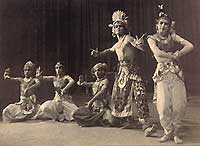
India has a very rich tradition of classical dance. The Natya Shastra, which is the oldest surviving text on stagecraft in the world, spends a considerable time discussing it. In the old days of the theatre, the dancers would mime the story while the singers would sing the dialogue. The instrumentalists would accompany them all. The nature of the old theatre was such that the dancers occupied a central position.

For many centuries the dancers were attached to the temples. This maintained a strong religious flavour to dance. Even today many of the traditional themes are mythological in nature.

Over the centuries different areas have given their own colour to the ancient classical tradition. Today the acknowledged classical styles are: Bharatnatyam of Tamil Nadu, Kathakali of Kerala, Kuchipudi of Andhra Pradesh, Manipuri of Northeast India, Orissi from Orissa, and Kathak from north India and Pakistan. Each of these styles has a strong regional connection and none can claim to be representative of the entire Indian subcontinent.

CLASSICAL DANCE

It is particularly problematic to talk of classical Indian dance. The problem stems party from the definition of the word "classical", and partly from the nature of the Indian dance forms.

We will use three simple benchmarks to determine whether something is "classical". The first benchmark is age. The second is its ability to cross ethnic boundaries, and third is class associations.

Age is the first benchmark to come to anyone's mind. It is generally acknowledged that for something to be considered classical, it must have great age. This seems simple at first, but it begs the obvious question of how one determines age. Clearly every performance exists in the here-and-now, so the performance itself cannot be used. Although the performance may not be used to determine age, we might consider using the genre. This would be acceptable to many people; however if this is used, it is surprising how recently some genre have developed. Bharat Natyam for instance only goes back to the early 20th century! Since the genre also produces ages which are not acceptable in traditional Indian world views, most Indians would use the tradition to define age. (The relationship between performance, genre, and tradition will be discussed later.)

The ability to span different ethnic groups is another common benchmark. This is best illustrated by a simple model put forth by the anthropologist, Robert Redfield in the early to middle part of the 20th century. According to Redfield's model, there are "great" and "little" traditions. We may simplify theses concepts by saying that "little" traditions are the folk traditions while the "great" traditions are the classical traditions. The "great" tradition of European classical music was able to span the different ethnic groups that extend from Russia, throughout Europe, and even into the new world, yet the "little" folk traditions remained isolated to smaller geographical areas. It is in this same manner that Carnatic classical music spans the diverse cultures of Tamil Nadu, Kerala, Carnatica, or Andhra Pradesh.

Cultural connotations are also a benchmark for determining whether something is classical. "Classical" arts tend to be used by the upper classes to define their cultural identity.

So we have three benchmarks to define "classical"; age, transethnicity, and class associations. These benchmarks work very well in describing Indian classical music (both Hindustani and Carnatic), but the various schools of dance tend to fall short in one or more areas.

This brings up the curious question of how many classical dance forms there are in India. Since all the various schools of dance are deficient in one or more of the benchmarks, one may argue that there are no classical dance forms in India. I think that most people would be dissatisfied with this proposition. On the other hand if we relax our criteria excessively, we find that there may be a dozen "classical" forms. I think that this too, is unacceptable to most people.

Therefore we will try and steer a middle path. One that will produce about half a dozen systems. If a reader wishes to take exception with our inclusion of a particular form as "classical", we certainly understand. As has already been stated there are ample reasons to disallow particular genres as being classical. By the same token if a reader takes exception to the exclusion of a particular genre, this too is understandable. It is our belief that the informed reader may make their own decision in these matters.


Indian Classical Dance Forum · Introduction to Indian Music · Bharat Natyam · Kathak · Odissi · Kathakali · Kuchipudi · Manipuri · Mohiniattam · Andhra Natyam · Folk Dance · Works Cited

For further information go to:

http://chandrakantha.com/articles/indian_music/nritya.html


Ohter Links
Send an E-Mail

International
Teacher Index

Other Websites
of Tarang

Performance Pictures mainly from Molly Roy and Sajal Karmakar Pictures from a students performance Sajal Karmakar gives vocal lessons Lessons in indian vocal, classical and Bhajans Molly Roy Chaudhury, Master in Kathak and Bharatnatyam Lessons in Kathak a rhythmical style of classical indian dance Sajal Karmakar, Tabla Maestro and Teacher Tabla- Teaching Teaching Program of Tarang's School The whole world of indian musical instruments Tablas in different price and quality categories Tabla Link Directory with lot of Information Indian Dance Link Directory with lot of Information Link directory on Indian Music with lot of information Register if you like to exchange Links with Tarang German Version of Tarang's Website Homepage Philosophy of Tarang Forum About Tarang Map of India International Teacher Index for Indian Instruments International Teacher Index for Indian Dance International Teacher Index for Tabla Register for the List of Music and Dance Teachers The World of Tabla: DVD Tutor with 6 months routine, Instruments, Accessories and lot of information The Whole Variety of Indian Musical Instruments in High Quality from well known Manufacturers Gongs, Singing Bowls and other Sound Instruments in High Quality Big Offer on CDs Tarang's Service on Astrology Tarang's Jewellery