BHARAT
NATYAM
by David Courtney, Ph.D.

Bharat
Natyam is the most widely known and exalted of the classical
Indian dances. Although it has been traditionally associated
with Tamil Nadu, it now has a strong presence throughout
India. Even outside of India, the majority of schools
that teach Indian dance teach this style.
The
history of Bharat Natyam is interesting. The genre of
Bharat Natyam was developed by amalgamating a number
of elements from the earlier forms of Dassi Attam and
Sadr. Dassi Attam was a dance form of the Deva Dassis
(temple dancing girls) while Sadr was a form found in
the palaces of southern India. A number of people contributed
to the development of Bharat Natyam, but the most notable
was E. Krishna Iyer of Madras (Chennai). This was in
the 1930's
It
is difficult to determine the age of Bharat Natyam;
this is due to the evolving nature of Indian dance.
Although Bharat Natyam evolved from Sadr and Dassi Attam,
there are differences. If one feels that Bharat Natyam
is different enough to be considered a distinct genre,
then we may safely say that it is only about 70 years
old. On the other hand, if we consider the differences
to be insignificant, then we may push the age back several
hundred years. However, the careless manner in which
many artists date Bharat Natyam back to the Natya Shastra
is absolutely preposterous. The cumulative changes that
have occurred over the last 2000 years make such statements
totally insupportable.
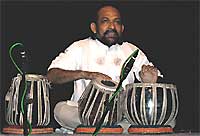
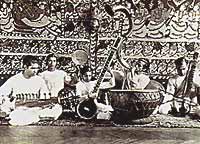
There
are a number of musicians and instrumentalist who provide
the musical accompaniment. Typically there is one or
more vocalist, a person reciting the dance syllables,
and a mridangam. Additionally, one usually finds violin,
vina (saraswati vina), or venu (bamboo flute). There
is also a thallam (manjira) which is usually played
by the person reciting the dance syllables. The overall
style of the Bharat Natyam musical accompaniment is
not unlike other Carnatic performances.
All
of the traditional elements of classical dance are present
in Bharat Natyam. The mudras (hand positions), abhinaya
(facial expressions), and padams (narrative dances)
form the basis for the performance.
There
are a number of well defined of items. Alarippu is a
traditional invocation. Jatis are strict compositions
based upon the different time-signatures. Another piece
is the Sabdam; this is an interpretative narrative,
usually performed in seven beats. Another form is the
Varanam; these are elaborate descriptions of the nature
of God. Another piece which is usually performed toward
the end of the performance is the Tillana; this is a
purely abstract form devoid of narrative. The performance
ends with a Mangalam; this is a short Shloka in praise
of God.
For
more information go to:
http://chandrakantha.com/articles/indian_music/nritya/bharat_natyam.htm