The
oldest instruments...
All
over the world, archeologists list simple idiophones
as the first prehistoric musical instruments. This includes
rattles, scrapers, and bone flutes (without holes).
The neolithic strata contains slit drums, flutes (with
holes), shell trumpets, and musical bows. The paleolithic
strata yields basket rattles, xylophones, flutes, friction
sticks. These early instruments, at least the instruments
which survived, often resemble tools that early society
utilized. In India, the doddu rajan, found among the
Savaras, resembles a fire producing implement (a tool
to create heat by friction). This type of scraper, also
found as the kokara among the Palayans of Kerala perhaps
became the Palayans' scraper, and used in the music
of exorcism.
Earthen
pots, used for cooking and storing grain, served as
percussion instruments. Examples are the noot, rouf
(Kashmir), matki (Rajastan), gugri, gagra (north India),
ghatam (south India). Since many of these instruments,
built out of perishable materials, did not leave evidence
for us to trace their history, we rely on sculptures,
paintings, and manuscripts which depict or describe
them.
top
The
seals of the Mohenjodaro
The
seals of the Mohenjodaro Indus valley civilization contain
depictions of men playing long cylindrical drums hung
around their necks played horizontally. These drums
are most similar to the kharrang of Assam and with the
dhole of the Reddis of Andra Pradesh. Other drums inscribed
on the seals include an hour glass shaped drum like
the hudukka, castanets and cymbals. Some arched harps
found in their hieroglyphics and unearthed clay whistles
demonstrate they developed a tonal system, but no literature
exists which we can translate in order to learn about
that system.
top
Vedic
literature
Our
first documentation of music occurs in the Vedic scriptures,
of the Aryan culture. The most ancient Vedic literature
describes drums covered with the skins of wild animals,
large earthen drums, and the role of the drums in various
rituals. The bhumi-dundubhi, a giant earth drum, consisting
of a hallow pit covered with skin, struck by legs of
wood, signaled danger or approaching enemies with its
thunderous and deep resonating pitch. Vedic singers
used the dundhubi, a drum formed out of hallow tree
trunks with the upper part covered with skin.
top
Literature
from the Nardiyasiksa and the Natyasastra.
A
great deal of our musical knowledge of India stems from
the Nardiyasiksa (written approximately around 100 B.C.E.)
and Bharata's Natyasastra, a later work during that
period which offers a scientific approach (also called:
the Natyaveda, panchamaveda, gamdarvaveda, or the "fifth"
veda).
Naradiysiksa, describes vedic and ghandharva music.
It states that semi-divine ghandharva music is composed
of three elements: svara, tala, and pada. Narad describes
the essentials of vocal and instrumental music. In the
31st and 32nd chapters, the Natyasastra gives descriptions
of tala, the fundamental aspects of India rhythm. According
to Bharata, tala was known as 'ghana' and time as 'kala'.
Laya, called kalapata, subdivided into vilamvita (slow),
madhya (medium), and druta (fast). Kala divided into
three parts, citra (two matras), vartika (four mantras),
and daksima (eight mantras). Bharata stated that tala,
or time unit, was known as the measurement of kala,
('kala kala pramanena tala ityabhdhiyate' 31.7). Two
kinds of talas existed, n'sabda (soundless or beatless),
and sa'sabda (with sound or beat). The soundless tala
again subdivided into 4 kinds: samya, tala, dhruva,
and sannipata. Other terminology regarding rhythm included:
yati (a method of applying a tempo of a tala -- of which
they had several kinds: sama, srotogata, gopuccha, damaru,
pipilika), prakarana (to make a song ready for singing),
satala (with any rhythm), atala (without rhythm). With
such terminology they clearly developed a complicated
rhythmic system. This originated before the classical
music age (600 to 500 B.C.E.), as ghandharva music became
obsolete before the Bharata period. Ghandharva music
provides the link between vedic music and post-vedic
marga type of music (which evolved around 700 B.C.E.,
and provides insight to the classical period as well.
top
During
the classical and post-classical period...
The
classical or post-classical period featured drums with
complex designs, like the puskara, bhanda, panava, and
mrdanga. The ancient dhundubhi became a prototype for
these drums, as well as, the bhanda vadya, the modern
pakhawaj and the khole. The puskara consisted of three
drums, two horizontal and one leaning drum. They tuned
these drums to defined pitches (gandhama, sadja, and
pancama -- the tones considered as the primal ones of
the gama or 'scales'). The bhanda vadya, mrdanga, and
the pakhawaj all have similar designs. Played horizontally,
these barrel shaped (almost cylindrical) drums, feature
a tuned multi-layered composite membranes covering both
ends (connected by leather straps).
top
Other
drums found in India during this period...
Other
drums found in India during this period include the
madal which features a similar but less sophisticated
design. This drum is found among the Santals, Oraons,
Baigans, and Ghasias (all the non-Aryan people of the
central Indian belt). Similar drums existed throughout
India with variations on this name: maddale (Kannada),
madol (Bengalic), mandar (Hindi), mardal (Sanskrit),
maddelam (Tamil). Other double membrane drums from this
period include: the tavil (Tamil), the pung (Manipur),
and the khole (Bengal).
top
Origins
of the tabla, and development to present day.
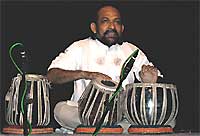
The
tabla developed as a hybridized drum, influenced by
all of these varieties, in particular, the mrdangm and
the puskara. Muktesvara temple (6th-7th century) and
Bhuranesvara (and three other cave temples) of Badari
in Bombay (6th century) contain depictions of the Puskara.
Musicians often placed the puskara's smaller verticle
drum (called 'alinga'), on their lap and played more
than one drum at a time. Given the the design, technology,
and musical structure for drums common in this this
period, we can piece together numerious features of
the tabla.
The name 'tabla', probably derived from the Arabic word
for a drum (generic), called the 'tabl'; and possibly
to some extent the Turkish word 'dawal'. Another popular
notion is that Amir Khursuro invented the tabla by splitting
the Pakawaj into two drums. This is highly disputed.
Abul Fazil, the court recorder neither mentions nor
describes the tabla, leaving doubt that Amir Khursuro
invented the tabla, contrary to a previously popular
notion. The Muslim invaders undoubtedly influenced the
culture and structure of the tabla. However, the earliest
depictions and literature describing the tabla as we
recognize it today come from the 18th century.
Details available from this point on enable us to chart
the development to modern day. Over the last two centuries
the tabla begins to take the forefront of percussion
instruments in north Indian classical music. We can
trace the family lineage of the gharanas from the 18th
century onward. Over this time, the tabla slowly changed,
the dayan decreasing in size while the bayan increased.
During this time the instrument slowly became the primary
drum for both classical and popular music of north India.
top